Digital··6 min
Fit 4 Digital: a €5,000 diagnostic, 100% funded for SMEs
Eligibility rules, the timing mistake that costs you the grant, the real rates after the diagnostic: how a Luxembourg SME can use the Fit 4 Digital programme.
Translated from French · Lire l'original en français

A €5,000 digital diagnostic, 100% funded by the Ministry of the Economy: the Fit 4 Digital programme, run by Luxinnovation, is one of the most generous grants open to a Luxembourg SME. It is also one of the easiest to lose, because of a timing rule that many managers discover too late. Here is what the scheme actually funds, who can apply, and what the State still pays for once the diagnostic has been delivered.
What Fit 4 Digital pays for exactly
The programme funds a single, flat-rate service: a digital maturity diagnostic carried out by an external consultant. Its cost is set at €5,000 excl. VAT, and the grant covers the full amount, according to guichet.public.lu. Once the procedure has been completed, the company therefore pays nothing for the diagnostic itself.
Luxinnovation states a timeframe of six months maximum between submitting the application and receiving the action plan. This plan is the real deliverable: it lists the actions to be taken and costs them item by item, separating consulting fees from hardware and software investments.
What the programme does not pay for should be made clear straight away: it funds no implementation at all. Buying an ERP, rebuilding a website or migrating infrastructure does not fall under Fit 4 Digital but under other schemes, described below.
The three conditions that most often block applicants
Three criteria govern access, and the first regularly catches people out.
- More than three years in business. Luxinnovation requires an SME “basée au Luxembourg depuis plus de 3 ans” (“based in Luxembourg for more than 3 years”). A recently created company, however well structured, is excluded from the programme. This is the least anticipated reason for rejection.
- A valid business permit (autorisation d'établissement), issued by the Direction générale des PME (the ministry's directorate for SMEs).
- A business sector that is not excluded. The sector exclusions that apply to SME aid apply here too. As the list is open to interpretation depending on the company's actual activity, check it with Luxinnovation before applying.
The timing mistake that costs you the grant
This is the most expensive point, and guichet.public.lu sums it up in one sentence: “L'entreprise doit introduire une demande Fit 4 Digital avant de signer tout devis qui l'engage avec un consultant.” (“The company must submit a Fit 4 Digital application before signing any quote that commits it to a consultant.”)
The reasoning is the incentive effect, common to all European state aid: a subsidy can only reward a decision it helped to trigger. In practice, a manager who meets a consultant, reaches an agreement, signs the quote and only then submits the application has lost eligibility. The order of steps is not an administrative formality, it is the core condition.
A second point to watch, this time for cash flow: the grant is paid after the service, on presentation of the voucher, the receipted invoice, proof of payment and a copy of the diagnostic report. The company therefore advances the €5,000 before being reimbursed.
What the consultant actually audits
Contrary to a common belief, the diagnostic is not limited to the website or marketing tools. It covers three areas: IT infrastructure, IT security and business software.
For the last area, Luxinnovation specifies the scope: applications used for production, inventory management, planning, invoicing, accounting, human resources and e-commerce. In other words, the entire management chain, not just the shop window.
The six steps, from application to payment
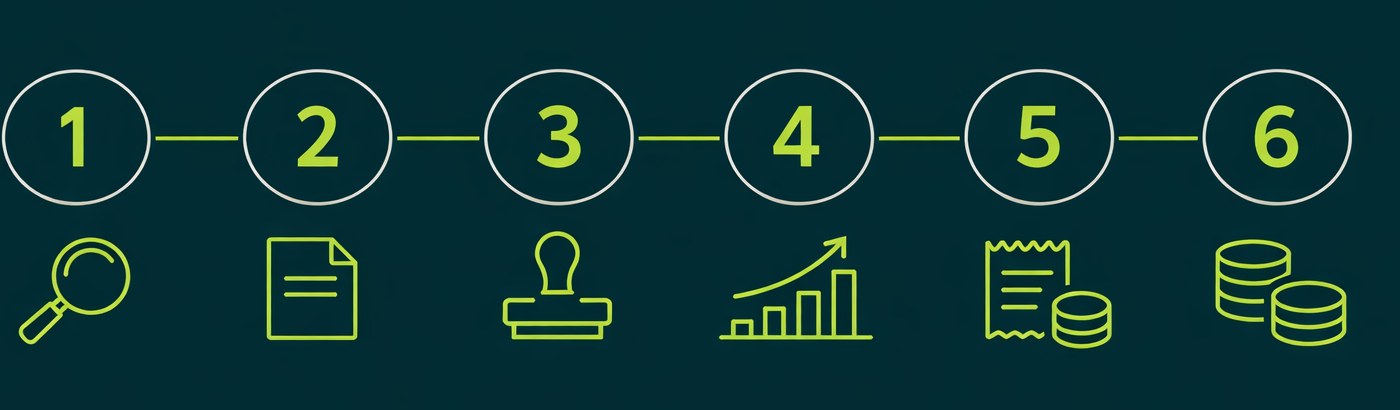
- 1 Choose a consultant from Luxinnovation's directory of approved consultants
- 2 Submit the application on the Luxinnovation platform
- 3 Eligibility check, then referral to the ministry
- 4 Diagnostic carried out and report validated
- 5 Submission of the voucher, receipted invoice and report
- 6 Grant paid by the ministry
The choice of consultant is not free: they must appear in the directory of consultants approved by Luxinnovation, which offers help with the selection. This constraint has one advantage, filtering out improvised providers, and one drawback, limiting competitive tendering.
After the diagnostic: what the State still funds
The action plan creates no obligation. The company alone decides whether or not to implement the recommendations. If it does, it moves to the general SME aid scheme, whose rates are considerably lower and, above all, vary with company size.
The difference between 20% and 10% is decisive and often misreported. Several pages on the subject state “environ 20 %” (“around 20%”) for the investment phase: that is the rate reserved for small enterprises. A medium-sized enterprise, as defined by the EU, receives only 10% of eligible costs. A manager who budgets on the basis of the first figure ends up with half the expected aid.
Two limits complete the picture. First, simple equipment replacement and the purchase of isolated assets are excluded from eligible costs: the investment must involve a creation, an extension, a diversification or a fundamental change in process. Second, the aid cannot be less than €1,000 per project, which rules out very small expenditures. The whole system rests on the amended law of 9 August 2018 on an aid scheme for SMEs and on EU Regulation 651/2014.
Estimate your aid in thirty seconds
The simulator below applies the published rates to the amount of your planned expenditure. It gives an order of magnitude to help prepare a budget, in no way an award decision: only the Ministry of the Economy rules on an application.
Simulator
How much could your SME receive?
Estimated public aid
€20,500
- Diagnostic, 100%€5,000
- Consulting, 50% maximum€7,500
- Investment, 20%€8,000
Please note: this estimate does not reflect any decision by the Ministry of the Economy, and assumes the investments involve a creation, an extension, a diversification or a fundamental change in process.
If you are not eligible
A company created less than three years ago is excluded from Fit 4 Digital, but not from all funding. The SME Packages scheme has no such age requirement and reimburses 70% of a project costing between 3,000 and 25,000 euros excl. VAT, with aid capped at €17,500. It now covers four strands: Digital, Energy transition and, since 2025, Artificial intelligence and Cybersecurity.
The two schemes follow different logic: Fit 4 Digital funds upstream analysis, while SME Packages funds a project that is already defined, backed by a quote. We have covered the SME Packages scheme and its €17,500 cap in detail, as well as the comparison of the two schemes before a digital overhaul.
On the implementation side, several Luxembourg providers position themselves on the Digital strand of these programmes. NEO Agency, which specialises in search engine optimisation in Luxembourg, for example, advertises a dedicated SME Packages offer. The choice of provider remains with the company, and Luxinnovation publishes the list of approved providers for each strand.
For specific cases, such as an excluded sector or determining the company's size category, the Ministry of the Economy can be reached on 247 74 704 and at [email protected].