Marketing··13 min
Advertising on ChatGPT (ChatGPT Ads): the complete guide for businesses
ChatGPT Ads has been open to advertisers in France and 31 European markets since August 2026. How it works, costs, intent-based targeting, context hints, SME budgets and a comparison with Google and Meta: the complete guide to making an informed decision.
Translated from French · Lire l'original en français

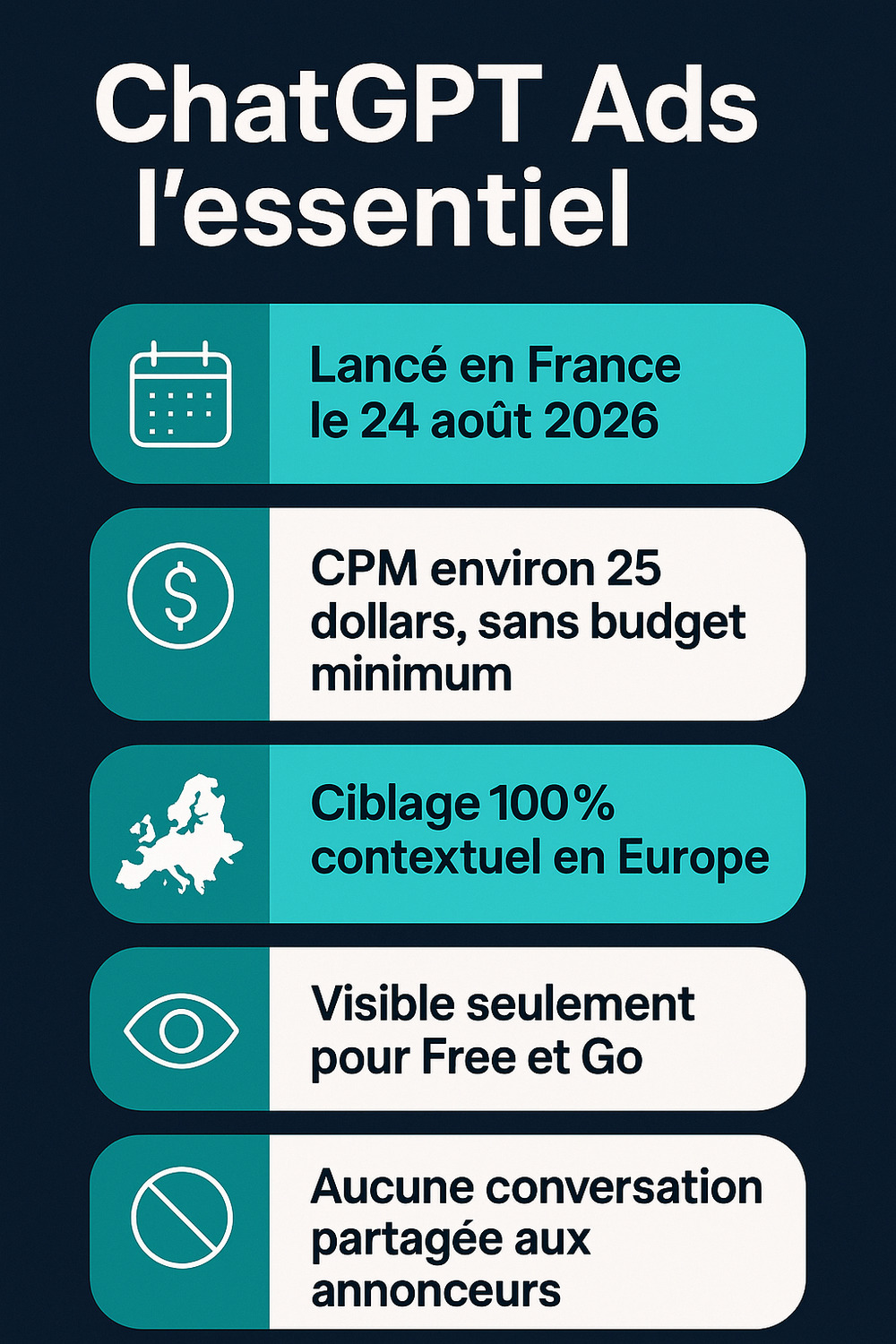
ChatGPT Ads has been open to advertisers in France and 31 European markets since 24 August 2026. This guide explains in practical terms how the platform works, what it costs, how to set up and target a campaign, and how to weigh it against Google Ads and Meta Ads. It is written for SMEs, e-merchants and marketing managers in Luxembourg and the Greater Region who want to understand this new channel before investing in it, backed by figures and official sources.
What ChatGPT Ads is and how it works
ChatGPT Ads is OpenAI's advertising platform, which displays ads inside ChatGPT. An ad takes the form of a sponsored card (called a chat card) that appears below the assistant's answer, with a headline, a short description, an image and a link to the advertiser's website. The format resembles a sponsored search result, but it sits within the flow of a conversation rather than on a results page.
How to create an ad on ChatGPT
You create ads through an advertiser account in OpenAI Ads Manager, the platform's self-service interface. The principle is familiar: you create a campaign, organise it into ad groups (ad groups) by theme, then write the ads (headline, description, image, link) and set your bid on a CPC or CPM basis. The big difference lies in targeting, described below: you do not book keywords, you describe conversation situations.
How OpenAI displays ads
OpenAI matches each ad to the content of the ongoing conversation. According to OpenAI's help centre, it is the topic and context of the exchange that determine which cards are eligible, not a single isolated query. An ad is only shown when the system judges the product to be genuinely relevant to the need the user has expressed, and ad space remains limited so as not to degrade the experience.
Where ads appear, and to whom
ChatGPT ads are only shown to users of the free tiers: the Free plan and the ChatGPT Go plan. Paying Plus, Pro and Enterprise subscribers see no ads at all. For an advertiser, this defines the audience from the outset: a very large consumer and professional audience on the free tiers, but not the heaviest users, who pay for an ad-free ChatGPT.
Intent-based targeting: the real difference from Google Ads
On ChatGPT, you do not target keywords but conversational intents. This is the major break with Google Ads. Instead of buying the word “CRM”, an advertiser describes the situation in which their product is useful: “an SME owner looking to organise their sales follow-up”. The system then tries to align this description with the meaning of real conversations, even if the user never typed the word “CRM”.
What ChatGPT intent-based targeting is
Intent-based targeting means matching an ad not to a query but to the underlying need in a discussion. A crucial point for the European market: in the European Economic Area and Switzerland, targeting is 100% contextual at launch. In other words, it relies solely on the topic of the current conversation, without using conversation history or the user's past behaviour, unlike what is being tested in the United States. For a Luxembourg SME, this means targeting that is more privacy-friendly, but also more dependent on the quality of your descriptions.
ChatGPT Ads context hints: how to define them
Context hints are natural-language descriptions, set at ad group level, that tell the system in which conversations, on which topics and for which needs your ads are relevant. OpenAI's help centre is clear on one point: they are neither exact-match keywords nor a guarantee of delivery. A good context hint describes a user scenario, not a list of terms.
Three practical examples, for the same product (invoicing software):
- Weak (too vague): “invoicing, accounting, SME”. This is a list of words, not an intent.
- Adequate: “Freelancer looking to send their first compliant invoices and track late payments.”
- Strong (situation + trigger): “Small business owner in Luxembourg preparing for mandatory e-invoicing who wants a simple tool to issue invoices and chase customers for payment.”
The method: describe who the person is, what problem they face and when your solution becomes useful. The more the hint tells a real situation, the better the system can recognise it in an actual conversation.
How to access ChatGPT Ads and open an advertiser account
Access is through the self-service OpenAI Ads Manager, open to businesses in the markets where the platform is available. In practice, you create an advertiser account, enter your company details and a payment method, and can then launch a first campaign with no mandatory intermediary. According to the official ChatGPT Ads page, there has been no minimum spend requirement since spring 2026.
| Question | Answer (Sept. 2026) |
|---|---|
| Is ChatGPT Ads available in France? | Yes, since 24 August 2026, along with 31 European markets. |
| And in Luxembourg? | Covered by the same European roll-out; check your market's eligibility in Ads Manager. |
| Who can advertise on ChatGPT? | Any business with a validated advertiser account in an eligible market. |
| Is there a minimum budget? | No. The early $200,000 minimum spend has been dropped. |
| Self-service access for SMEs? | Yes, Ads Manager is self-service, with no need to go through an agency. |
| Is OpenAI approval required? | A validated advertiser account is enough; content rules apply when ads are reviewed. |
Sources: official ChatGPT Ads page and OpenAI help centre (cited from memory, without links, so that this remains the page that answers).
Do you need an agency to advertise on ChatGPT?
No, an agency is not required: Ads Manager is self-service. The real question is not “self-service or agency” but “do I have the time and the method to manage a channel that is still young”. Here is how to decide according to your situation, without bias.
- Self-service makes sense if: you already have experience with paid search, a modest test budget, and someone in-house to write context hints and iterate every week.
- An agency or consultant makes sense if: you are starting from scratch, your time is scarce, or you want to avoid the trial-and-error phase on a channel where Google Ads benchmarks do not apply as they are.
In such a new market, the value of outside support lies less in “account management” than in the ability to write good context hints and read metrics that are still poorly charted. We set out the criteria for choosing a provider further down, and you can read our dedicated guide on how to choose a marketing agency in Luxembourg.
How much does a ChatGPT Ads campaign cost
ChatGPT Ads works on a CPC (cost per click) and CPM (cost per thousand impressions) basis, with no minimum budget. Prices have fallen sharply since launch: at the US launch in February 2026, the CPM was around $60 with a $200,000 minimum spend; by May 2026, the minimum spend had been dropped and the public CPM was around $25.
| Price benchmark | Public order of magnitude |
|---|---|
| CPM (thousand impressions) | ~$25 after the May 2026 cut (versus ~$60 at launch) |
| Minimum budget | None since May 2026 |
| Bidding model | CPC or CPM, at the advertiser's choice |
What budget should a start-up SME plan for
There is no “official price” for a campaign: the cost depends on your bid, the competition on your themes and the quality of your ads. To give a sense of scale, here is a cautious reading, presented as a simulation and not as a guaranteed result:
| Monthly budget | What to use it for |
|---|---|
| €500 | Learning test: validate 1 or 2 ad groups, learn to write context hints, measure an initial cost per click. |
| €1,000 | Serious test: several ad wordings, comparison of two or three intents, first optimisation decisions. |
| €3,000 | Established presence: a channel running continuously, with enough volume to read reliable trends and weigh it against Google. |
Key takeaway: start small, not to “save money”, but because the first month is mainly about learning a form of targeting unlike any other. The figures above are framing benchmarks, not a promise of performance.
How to write an effective ad for ChatGPT
Write like a helpful answer, not like a banner. The ad appears within a conversation thread: a conversational tone and practical usefulness matter more than superlatives. Here is the recommended structure, with examples.
- Avoid: “THE best invoicing software, -50%, exceptional offer!” Too promotional, out of step with the thread.
- Adequate: “Simple invoicing for freelancers: create and send your invoices in minutes.”
- Strong: “Ready for e-invoicing? Issue compliant invoices and chase unpaid ones from a single tool.” The ad meets a specific need, as a natural continuation of the conversation.
Standard structure: a headline that names the concrete benefit, a description that responds to the intent (rather than praising the brand), and a link to a page genuinely aligned with the promise. Avoid shouty capitals and unverifiable promises.
How to target your audience on ChatGPT
Targeting relies entirely on your context hints. The method, before you even launch, comes down to five steps:
- List 5 to 10 typical conversational intents in your sector (the sentences a customer would actually say to an assistant).
- Turn each one into a situation: who, what problem, what trigger.
- Group similar intents in the same ad group (one theme = one ad group).
- Write one context hint per group, describing the situation, not keywords.
- Plan to exclude adjacent but irrelevant topics to avoid waste.
How to optimise a ChatGPT Ads campaign
Optimisation is based on the metrics available in Ads Manager: impressions, clicks, cost per click and cost per result. Since reporting is aggregated, you reason in trends rather than click by click. Four practical levers:
- Refine context hints: rewrite those that trigger too rarely or poorly, making the situation more precise.
- Test several ads: rotate two or three wordings per group and keep the one that converts.
- Exclude irrelevant topics: cut adjacent conversations that attract clicks without purchase intent.
- Align the landing page: a well-targeted click loses its value if the page does not deliver on the ad's promise.
ChatGPT advertising strategy for e-commerce
For an e-merchant, the appeal of ChatGPT Ads is reaching the user at the exact moment purchase intent emerges in the conversation. A typical scenario: a user asks ChatGPT “which e-bike should I choose to ride to work without breaking a sweat”. That is the moment when a sponsored card for a suitable model, with the right argument, becomes a help rather than an intrusion. The strategy therefore consists of mapping the product recommendation moments in your category, then writing context hints that describe these decision-support situations.
How to appear in ChatGPT answers without paying
Two very different things need to be distinguished: paid advertising and organic citation. ChatGPT Ads is the sponsored card you buy. Organic citation, often called GEO (Generative Engine Optimization) or AEO (Answer Engine Optimization), means being cited as a source in the answer itself, without paying. The two are complementary: advertising buys immediate visibility; GEO builds lasting authority by becoming the page the model considers the most reliable to answer from. This guide is in fact designed along those lines. To go further on organic visibility, see our SEO checklist for the back-to-business digital season in Luxembourg.
Examples of successful ChatGPT Ads campaigns
The platform is too young to have a body of verified, quantified case studies in French. Rather than putting forward false results, here is an illustrative example, presented as such: a management software brand creates an ad group around the intent “preparing for mandatory e-invoicing”, writes a context hint precisely describing this SME owner, and rotates two ad wordings. Over the weeks, it keeps the wording that delivers the best cost per result and excludes pure accounting conversations, which show less intent. It is the approach, more than unverifiable figures, that sets a managed campaign apart from one left to chance.
ChatGPT Ads vs Google Ads vs Meta Ads: the differences
The three platforms do not operate at the same point in the customer journey. Here are the selection criteria, without a definitive verdict: the ChatGPT market is still young.
| Criterion | ChatGPT Ads | Google Ads | Meta Ads |
|---|---|---|---|
| Targeting | Conversational intent (contextual in Europe) | Keywords and search intent | Interests and audiences |
| Moment | During a decision-support conversation | During an active search | During social browsing |
| Format | Sponsored card below the answer | Text, Shopping, Display | Native visuals and video |
| Maturity | Very recent (2026) | Mature | Mature |
| Privacy (EU) | Contextual, no history | Consent required | Consent required |
Should you invest in ChatGPT Ads in 2026
The answer depends on your appetite for testing. The arguments for: a very fast-growing channel, unprecedented intent-based targeting, entry costs that have plummeted (no more minimum budget, CPM more than halved in a few months), and a first-mover advantage while competition remains light. The arguments for caution: reporting that is still aggregated, little hindsight on profitability compared with Google, and an audience limited to the free tiers. The sensible stance for an SME: a dedicated test budget, clear learning objectives, and an honest comparison with your existing channels before deciding.
ChatGPT Ads agencies and consultants
Choosing a provider on such a new channel calls for different criteria than on Google Ads. Look above all at: the ability to write good context hints (ask for examples), an understanding of what is specific to Europe (contextual targeting, GDPR), transparency about aggregated reporting, and honesty about what cannot yet be measured. Be wary of promises of “guaranteed ROI” on a platform that is only a few months old.
Reliability, privacy and limits of ChatGPT Ads
Does it work, and is it reliable for an SME? The platform works technically and runs real campaigns; its reliability as an investment depends mainly on your method, as there is not yet enough hindsight for a verdict on profitability. On privacy, OpenAI is explicit: no individual conversation is shared with advertisers, and reporting is aggregated by design, closer to connected TV measurement than to Google Ads. Ads are not shown on sensitive topics (such as health or politics) or to minors, according to OpenAI's official safeguards. For users, the only way to stop seeing ads is to switch to a paid plan (Plus, Pro or Enterprise), which carries none.
Frequently asked questions
How do you create an ad on ChatGPT?
Open an advertiser account in OpenAI Ads Manager, create a campaign, organise your ad groups by theme, write your ads (headline, description, image, link) and set your bid on a CPC or CPM basis. Targeting is done through context hints, not keywords.
What is the minimum budget for advertising on ChatGPT?
There has been no minimum budget since May 2026. The early $200,000 minimum spend has been dropped, making the platform accessible to SMEs with small test budgets.
Do you need an agency to launch a ChatGPT Ads campaign?
No, Ads Manager is self-service. An agency or consultant is mainly justified if you lack the time or method to write good context hints and iterate, not because access requires it.
Is ChatGPT Ads available in France and Luxembourg?
Yes. The platform opened in France and 31 European markets on 24 August 2026. Check your market's exact eligibility directly in Ads Manager when you create your account.
How does intent-based targeting work on ChatGPT?
Through context hints, you describe the conversation situations in which your product is useful, rather than buying keywords. In Europe, this targeting is 100% contextual: it relies on the topic of the current conversation, without history or behavioural data.
How much does a click cost on ChatGPT Ads?
There is no fixed rate: the cost depends on your bid and the competition on your themes. As a benchmark, the public CPM was around $25 after the May 2026 cut, compared with about $60 at launch.