Digital··5 min
Jeff Sonhouse in Luxembourg: when “Particulaars” questioned the mask and race
In 2016, the Zidoun-Bossuyt gallery gave New York painter Jeff Sonhouse his first exhibition in Europe. A look back at a show that left its mark on the Grund.
Translated from French · Lire l'original en français
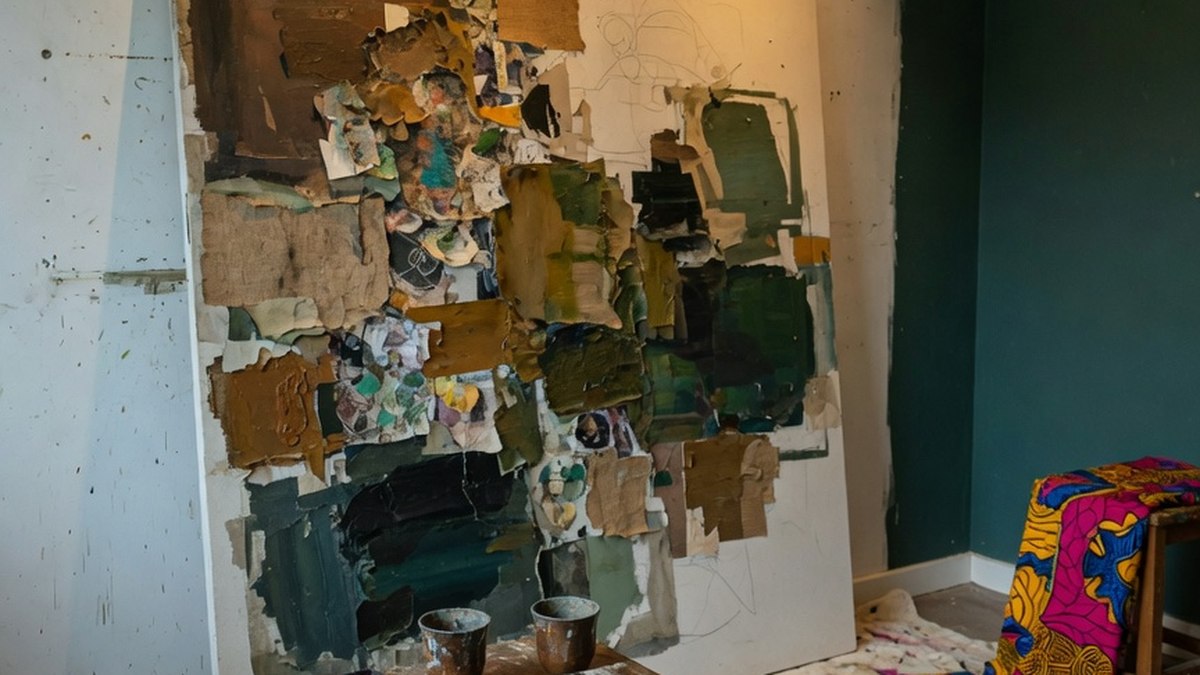
In September 2016, the Zidoun-Bossuyt gallery, tucked away in the Grund district of Luxembourg City, opened its walls to an artist whom few European collectors had yet seen in person. With “Particulaars: An exhibition of new works by Jeff Sonhouse”, it gave the American painter his very first solo exhibition on the continent. Ten years later, the exhibition remains a reference point for anyone interested in the place of African American contemporary art on the Luxembourg scene, and in what the art market can bring to a financial centre that also cultivates its own relationship with patronage.
Who is Jeff Sonhouse
Born in New York in 1968, Jeff Sonhouse earned a B.F.A. from the School of Visual Arts in 1998, then an M.F.A. from Hunter College in 2001. A recipient of grants from the Joan Mitchell Foundation and the New York Foundation for the Arts, he established himself during the 2000s as one of the most distinctive voices in American figurative painting focused on Black identity. His subjects have included Colin Powell, Michael Jackson, Diddy and Condoleezza Rice, the latter as part of his 2008 exhibition “Pawnography”, in which he broke for the first time with his exclusively male subjects.
His technique is instantly recognisable. Sonhouse builds his portraits in layers: collages cut from magazines, steel wool, welded metal and, above all, wooden matches, sawn and assembled into patterns, often large Afro hairstyles. He lights them, lets them partially burn, then fixes them to the canvas, so that the smoke and scorch marks become integral parts of the work. Over the faces of his Black male figures, he overlays a diamond-shaped harlequin pattern that conceals as much as it reveals, reminding viewers that these images, however realistic their execution, remain first and foremost symbolic.
Particulaars, a manifesto exhibition
The title of the Grund exhibition, “Particulaars”, plays on the idea of appropriation: Sonhouse repurposes prized works and objects by other artists to build his own compositions. In “Culprit Strange”, he takes up Picasso's Harlequin, a gesture that allows him to question what the Spanish painter had himself borrowed from African sculpture several decades earlier. In “Our Blues Don't Jibe”, it is the Black liberation flag designed by Marcus Garvey in 1920 that resurfaces, recomposed.
The centrepiece of the show reworked the American flag, its colours replaced by those of Pan-Africanism, populated with faceless heads crowned with burnt matches. The political charge of the whole was clear: police violence, systemic racism, echoes of movements such as Black Lives Matter, and the nagging question Sonhouse has been asking since the start of his career, namely how Black men are perceived, as a threat rather than as full citizens. According to Anne-Solène Groppe of the Zidoun-Bossuyt gallery, the artist “travaille principalement sur la question de la place et de l'image des Afro-Américains aux États-Unis” (“works mainly on the question of the place and image of African Americans in the United States”).
Why this exhibition made its mark
Sonhouse rarely exhibits. According to the gallery, “Particulaars” was his first major European presentation after almost eight years of absence from the continent. Bringing to Luxembourg an artist whose works circulate mainly between New York, Chicago and Atlanta was in itself a gamble for a gallery only recently established in the capital. The gamble paid off: the exhibition was covered in the local press as a rare dive, from the Grand Duchy, into the American racial question, at a time when it was taking up a growing place in public debate across the Atlantic.
This episode also illustrates a broader dynamic in Luxembourg: the emergence, since the early 2010s, of a network of galleries able to attract leading international artists, alongside institutions such as the Mudam. For the country's collectors and business decision-makers, this type of exhibition is not just an isolated cultural event: it contributes to the artistic credibility of a country that has long sought not to be defined solely by its financial dimension.
What this says about corporate patronage in Luxembourg
The Grand Duchy has a structured framework for this type of commitment. The Fonds culturel national (National Cultural Fund), Focuna, acts as an intermediary between the cultural world and the business world, and companies can choose between financial patronage, in-kind patronage or skills-based patronage. Several banks based on the Kirchberg plateau have built up substantial contemporary art collections over the decades, some of which have occasionally been opened to the public since 2008. The Mudam itself, with some 700 works spread over almost 4,000 m², remains the most visible showcase of this collective cultural ambition.
For a Luxembourg executive or CSR manager, the story of “Particulaars” offers a simple lesson: supporting a gallery or acquiring a work by an artist such as Jeff Sonhouse is not a risk-free communication gesture, but a choice that commits the company's image on sometimes sensitive subjects. This is also what distinguishes genuine cultural patronage from mere event sponsorship: it means standing by the content of what you support, including when that content is uncomfortable. Ten years after his time in the Grund, Sonhouse's work continues to circulate at American fairs and institutions, proof that an exhibition modest in size can leave a lasting mark, well beyond the circle of gallery regulars.